


Generative artificial intelligence has matured from a novelty into a routine utility for producing high-fidelity text, imagery, and video. By translating single-sentence prompts into complex media assets, modern foundation models have fundamentally decoupled creative production from traditional computational overhead. Virtual reality content creation, however, has lagged behind this curve. Interactive 3D environments, assets, and spatial scenes are still engineered primarily through intensive, manual asset-authoring workflows.
At VibeOS, our virtual reality division (VibeVR) addresses this bottleneck by introducing generative VR—a framework that dynamically synthesizes and renders spatial environments and objects using web technologies. Built on top of the WebXR API, our architecture leverages AI Orchestration Layers to translate natural-language voice instructions into deterministic runtime operations. This system maps natural language directly onto application-level action definitions, allowing the VR application to construct, position, and render assets in real time without predefined local libraries.
This article details the underlying architecture of our real-time, voice-to-object generation framework. To demonstrate its practical application, we evaluate its performance within Hologram Desk: an immersive, spatial engineering environment where users can vocally specify complex mechanical parameters and instantly inspect the generated 3D components within a VR headset.
AI Orchestration Layer Architecture
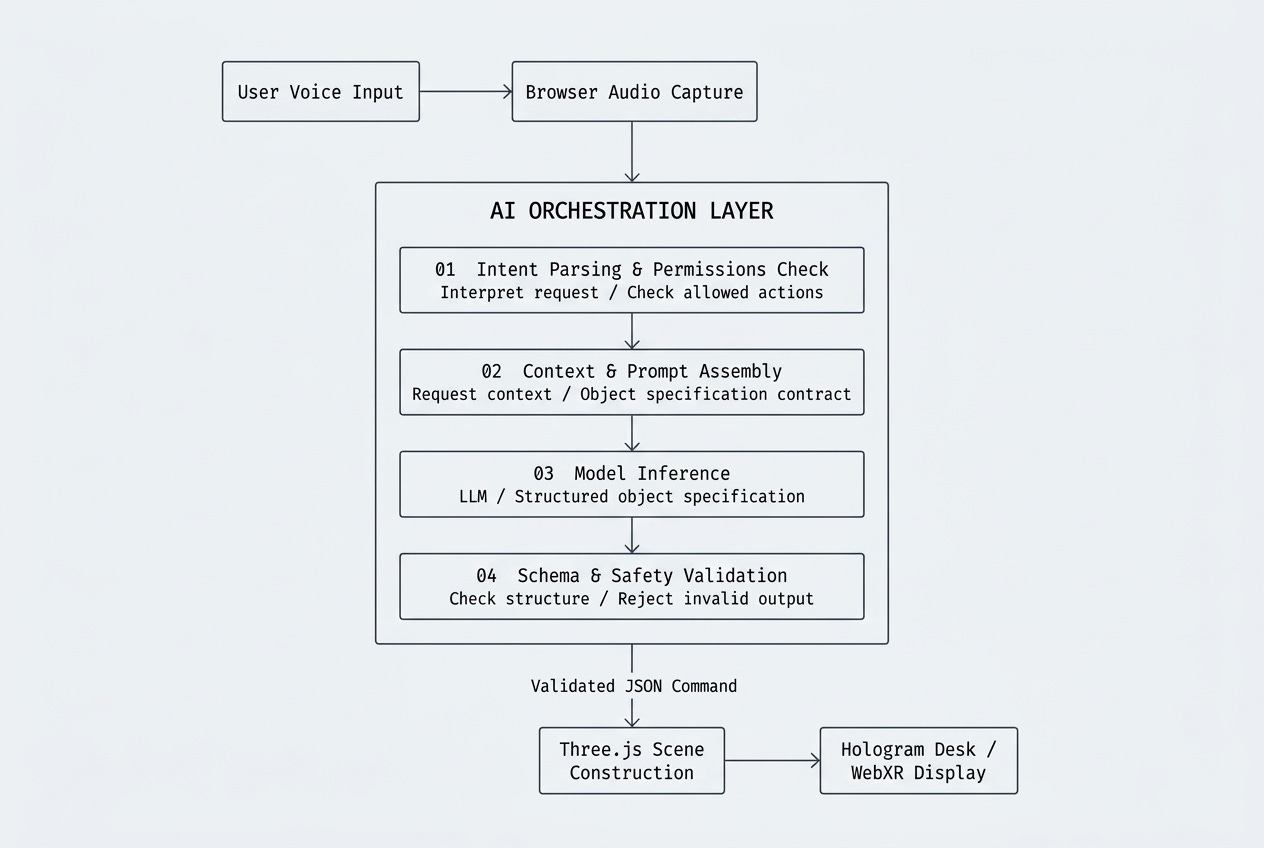
To bridge the gap between unstructured semantic inputs and deterministic spatial rendering, the system architecture relies on an AI Orchestration Layer. This software abstraction sits directly between the foundation models and the target runtime environment. The layer owns four responsibilities: context assembly, routing, transaction validation, and programmatic control. It standardizes incoming requests, evaluates token permissions, fetches external state variables, and parses non-deterministic model outputs into typed, executable application logic.
An orchestration layer is structurally necessary because large language models (LLMs) operate on probabilistic next-token prediction. While a sophisticated model can generate highly plausible responses to varied prompts, it lacks native mechanisms to guarantee compliance with API schemas, respect security or user permission boundaries, or handle missing parameters gracefully. Exposing a runtime directly to raw model outputs introduces significant risk, such as action injection vulnerabilities and unpredictable state changes. By placing a deterministic validation boundary before the execution runtime, the application ensures that no model output is executed until it has been explicitly parsed, verified, and sanctioned by the host system.
Furthermore, decoupling orchestration from the underlying inference engine provides crucial architectural flexibility. The layer handles the standardization of inputs, identity enforcement, prompt template injection, response contract validation, and audit logging. Because these invariant operational constraints reside within the application code rather than the model itself, developers can swap or update the underlying foundation models without modifying the core business logic of the application.
Hologram Desk VR Environment
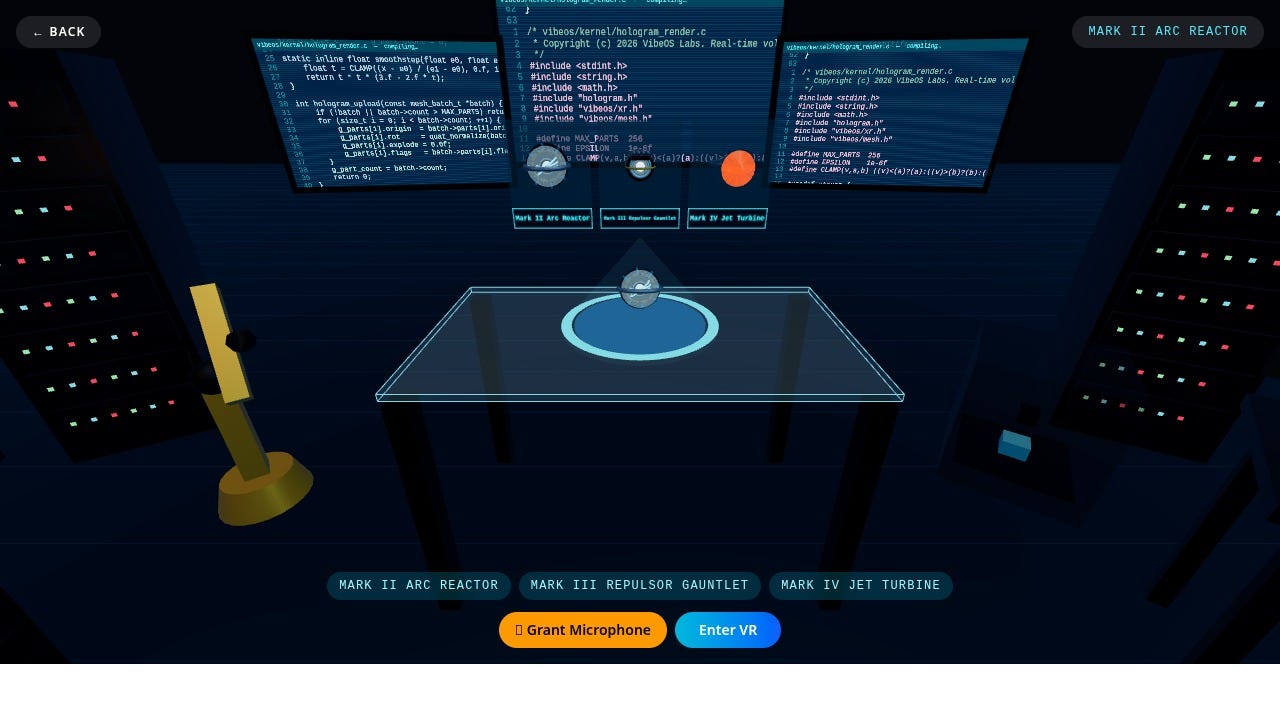
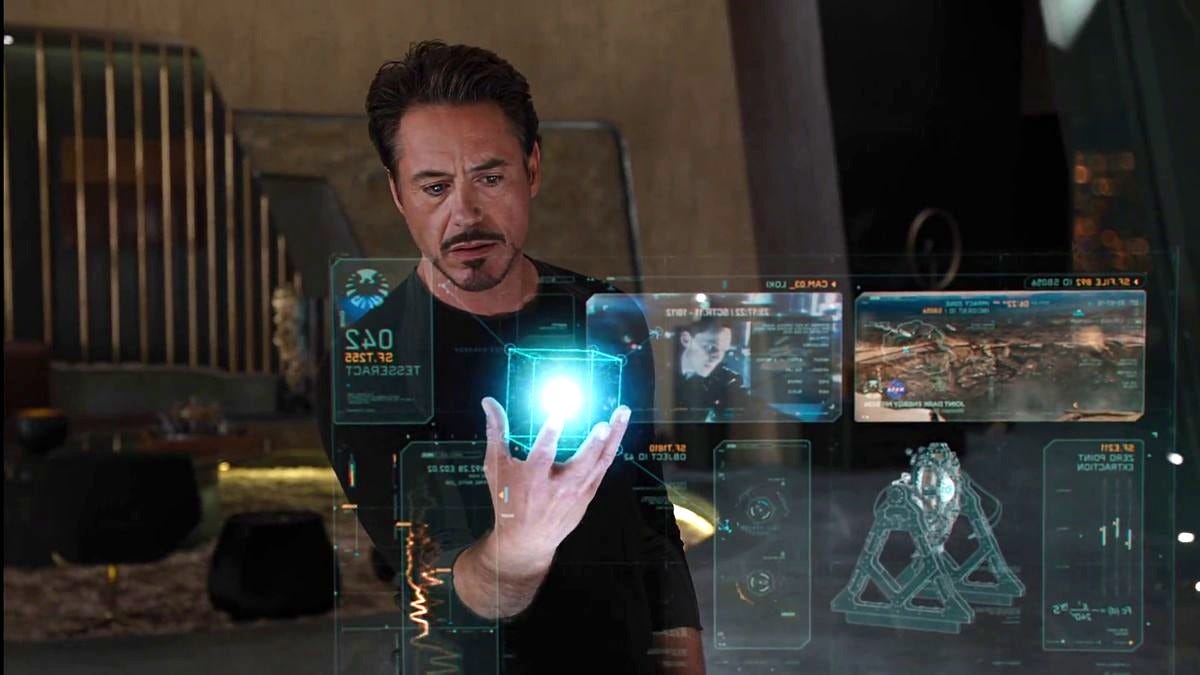
Hologram Desk is an immersive spatial computing environment within VibeOS Horizon, inspired by the holographic design tables Tony Stark uses in Iron Man. It provides a desk-sized workspace where users can inspect three-dimensional mechanical assemblies suspended above the surface. The scene is rendered with Three.js and presented through WebXR to a VR headset and tracked controllers, with controls for rotation, scaling, and exploded-view inspection.
In the immersive VR environment, the user is initially presented with three predefined reference models, the Mark II Arc Reactor, the Mark III Repulsor Gauntlet, and the Mark IV Jet Turbine, which are built into the application and act as fixed examples for testing the controls. The user can expand, collapse, and move the objects in a full 360-degree rotation. The user can also request, using natural language, to create new objects, which the application will generate. Once an object is generated, the user can use the controls to inspect it.
The voice-to-object pipeline
The architecture diagram above follows a request from spoken input to the displayed object. Its four orchestration stages sit between browser audio capture and Three.js scene construction. The following steps describe that sequence in Hologram Desk.
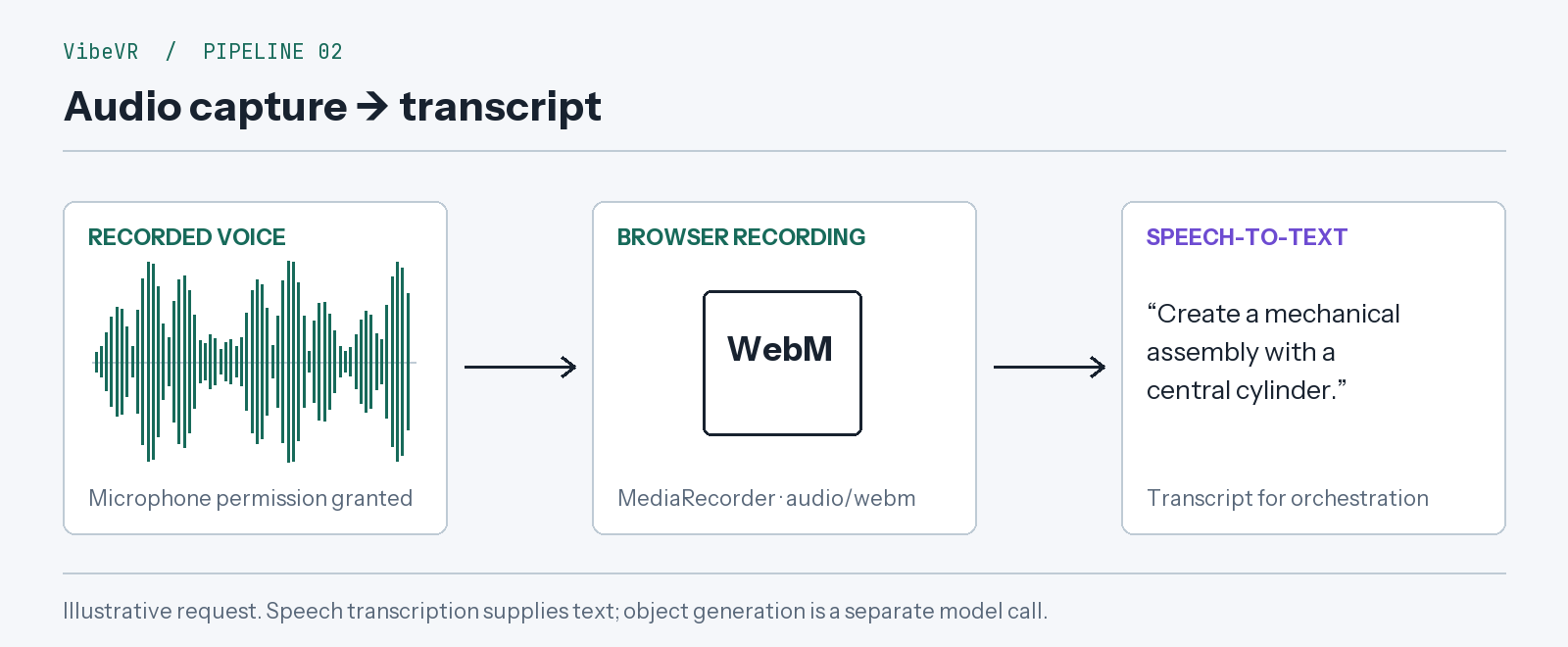
User voice input.The user describes the object to create, including its components, shape, or other relevant details.
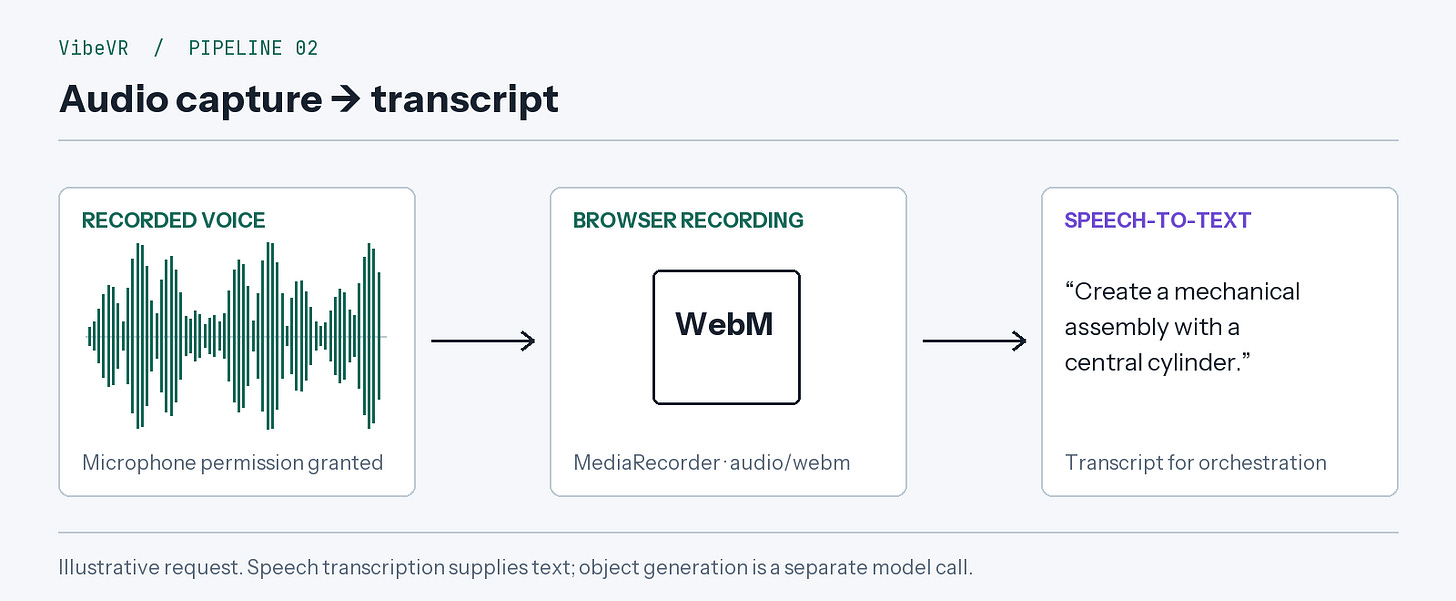
Browser audio capture.With microphone permission granted, the browser records the request as WebM audio. A speech-to-text model converts the recording into a transcript for the orchestration layer.
Intent parsing and permissions check.The application checks access to the generation service and requires usable transcript text before proceeding. The transcript supplies the object request; the application defines the available operation and the model’s permitted output.
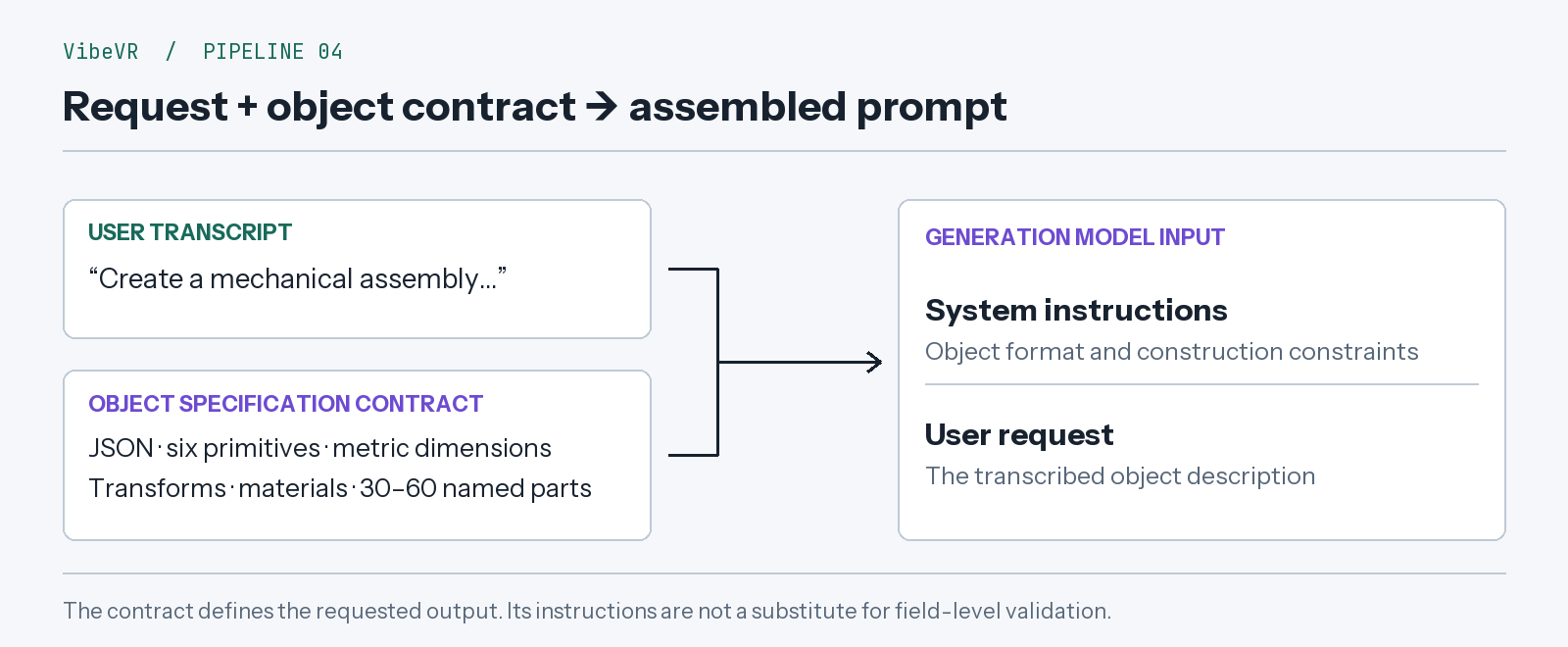
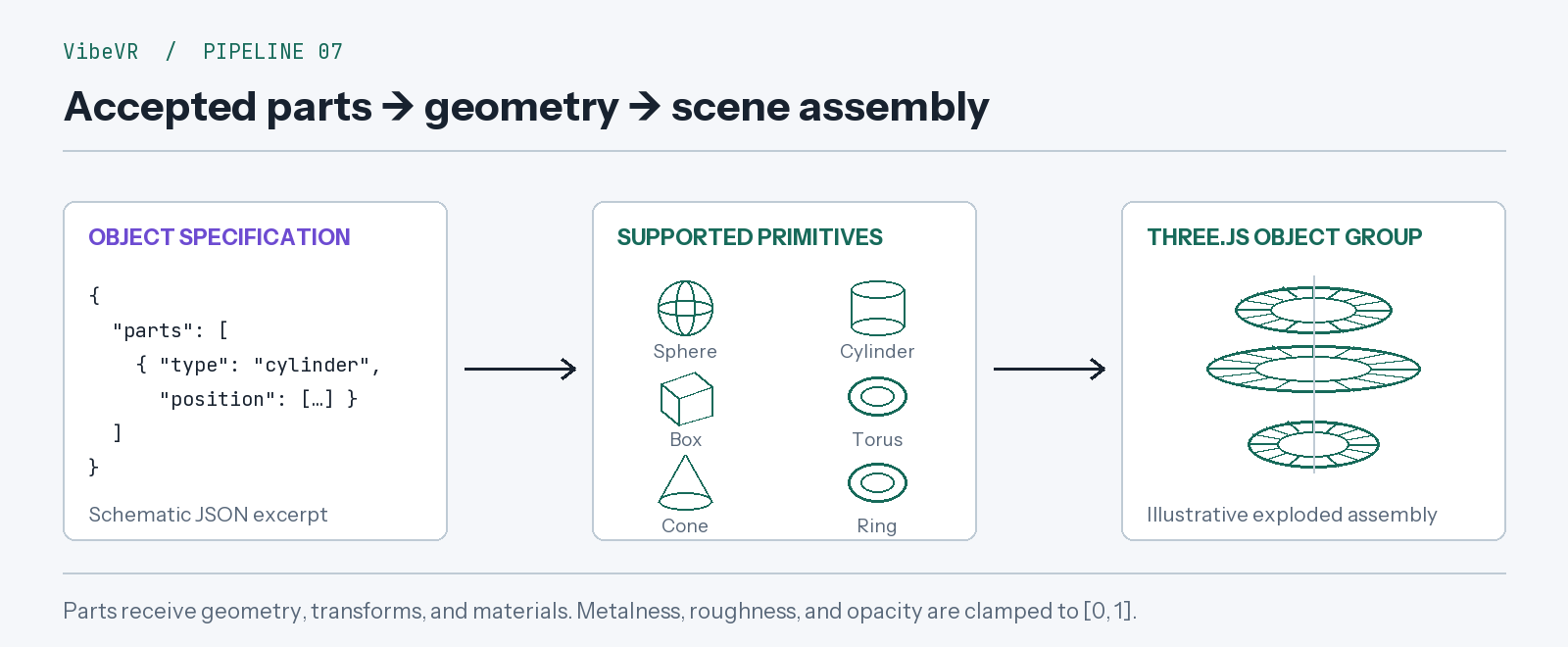
Context and prompt assembly.The orchestration layer combines the transcript with the object specification contract. These instructions define the JSON format, supported primitives, dimensions in metres, part transforms, material fields, and requested part count.
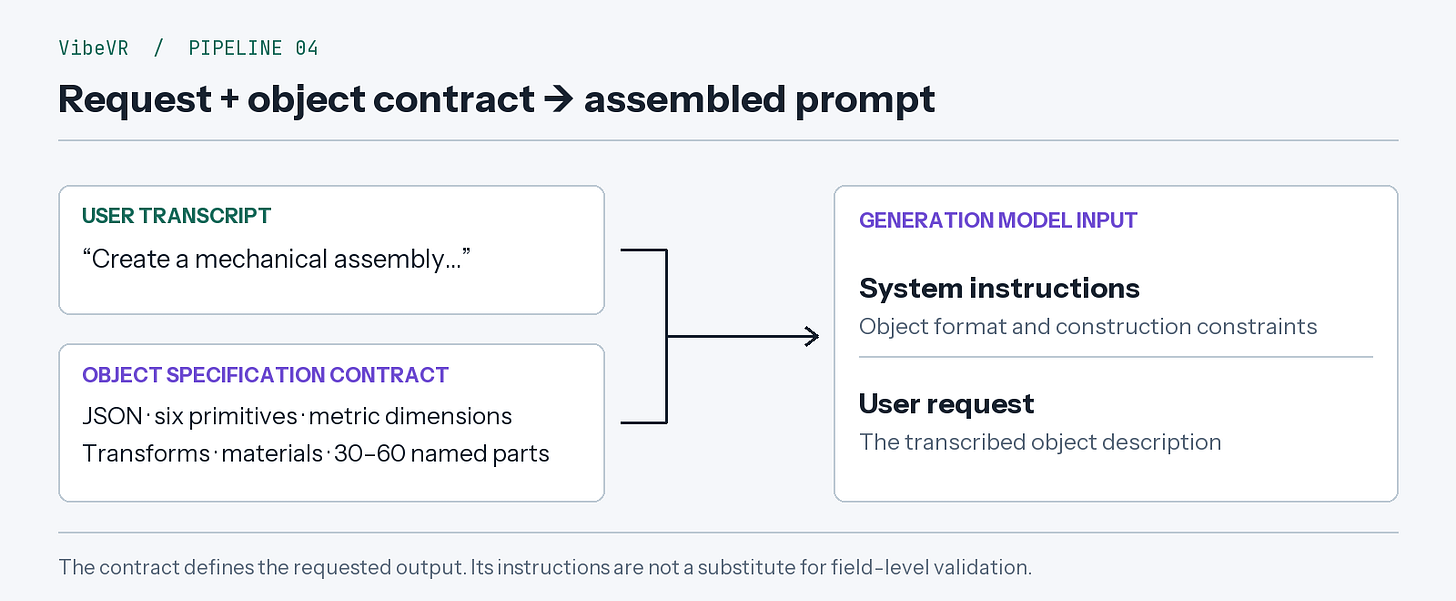
Model inference.The generation model processes the assembled prompt and returns a structured object specification. The response describes the assembly and its parts rather than providing executable rendering code.
Schema and safety validation.The application parses the response as JSON and checks that it contains a non-empty parts array. These are the prototype’s current response checks, not complete field-level schema or safety validation. The diagram’s “Validated JSON Command” refers to the object specification accepted after these checks.
Three.js scene construction.The renderer uses the accepted specification to create the assembly from supported geometry, transforms, and materials. It clamps material values to supported ranges and places the object in the Hologram Desk workspace.
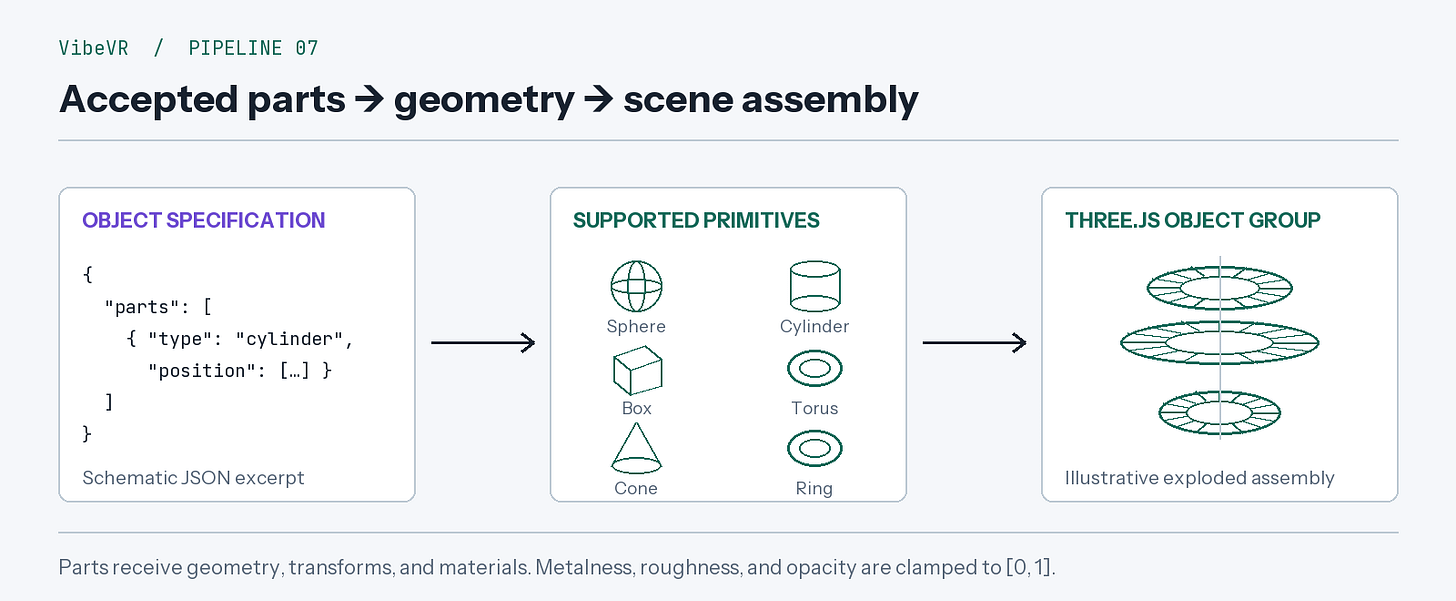
Hologram Desk / WebXR display.The object appears in the desk scene, where the user can rotate, scale, and inspect it in exploded view. The same scene is available through WebXR on a supported headset when the user selects Enter VR.
The Future of Generative VR
The Hologram Desk provides a functional pipeline for real-time, voice-to-object spatial generation. The execution sequence is direct: a spoken user request is transcribed, wrapped in an application context by the orchestration layer, and evaluated by the foundation model. The model then returns a structured data specification, which the application validates before programmatically building the asset in the scene. Because this entire sequence runs natively in the browser via WebXR, the application bypasses traditional asset pipelines and manual 3D modeling tools entirely, transforming speech into interactive geometry on the headset in seconds.
The same sequence extends from a single asset to the space around it. A specification can describe an environment as readily as an object: the surfaces, fixtures, and props that make up a room, a workshop, or an outdoor setting, with their positions and materials. Nothing in the pipeline depends on scale, so the step that assembles a mechanical component on a desk can assemble the environment that holds it. Hologram Desk today fixes that environment and generates only the object within it; the natural next step is a spoken request that defines the room itself.
This framework introduces several distinct operational advantages over traditional 3D workflows:
Democratized Spatial Authoring: By substituting natural language for specialized modeling software skills, the system allows anyone capable of describing an object or a space to generate 3D assets and environments.
Rapid Prototyping: In engineering and product design, the pipeline drastically shortens the development cycle between a conceptual idea and a reviewable physical model or a walkable environment.
Just-in-Time Production: In educational or technical training environments, instructors can instantiate precise mechanical components, or the setting that contains them, on demand to support a live lesson.
Reduced Overhead: For cross-functional teams lacking dedicated 3D art departments, the system removes the typical engineering bottleneck of waiting on an external asset pipeline just to test a spatial concept in VR.
VibeVR - https://vibevr.io
by VibeOS Technologies - https://tech.vibeoscloud.com